

Wisdom teeth are the last adult teeth to come through, and they do not always have enough room to emerge fully. A partially erupted wisdom tooth is one that has broken through the gum but has not reached its final position, leaving part of the tooth still covered by gum tissue. This situation is common, and it does not always require immediate action, but it does require monitoring.
At Beyond 32 Dental in Pennant Hills, Dr Jeff Lin and Dr Jennifer Chung take a careful, individualised approach to wisdom tooth concerns, reviewing each patient’s X-rays and clinical history before any recommendation is made.
Quick Overview
- A partially erupted wisdom tooth has broken through the gum but remains partly covered by gum tissue
- It may affect people in their late teens or early twenties, though timing varies between individuals
- Partial eruption can create conditions where bacteria accumulate, which may lead to infection, decay, or pressure on nearby teeth
- Whether symptoms develop, and how quickly, depends on the tooth’s position, available space, and oral hygiene habits
- A dental assessment with X-rays is the most reliable way to understand what is happening and what options exist
The sections below outline what a partially erupted wisdom tooth involves, what symptoms to watch for, what complications may arise, and how treatment is approached.
What Is a Partially Erupted Wisdom Tooth?
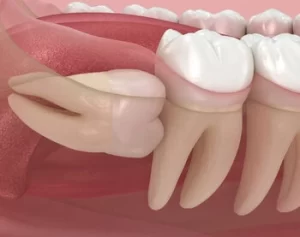 A partially erupted wisdom tooth is a third molar that has begun to push through the gum line but has not fully emerged. Part of the tooth is visible in the mouth, and part remains beneath a flap of gum tissue. This flap, known as an operculum, creates a space where food and bacteria can collect, which is one of the main reasons partially erupted wisdom teeth can cause problems.
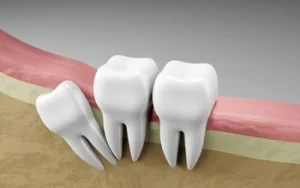
Wisdom teeth, also known as third molars, are the last teeth to erupt, usually between the ages of 17 and 25. Most adults have four, though some people develop fewer or none at all. When the jaw does not have enough space to accommodate these teeth, they may become partially or fully impacted.
What Are the Symptoms of a Partially Erupted Wisdom Tooth?
Symptoms vary between individuals. Some people experience significant discomfort, while others have little or no pain even when a wisdom tooth is partially erupted.
Common signs include:
- Pain or aching at the back of the jaw, which may radiate toward the ear or temple
- Swollen or tender gum tissue around the emerging tooth
- Difficulty opening the mouth fully, particularly when an infection is present
- Bad breath or an unpleasant taste, caused by bacteria accumulating under the gum flap
- Mild pain or pressure against the tooth in front of the wisdom tooth
Lower wisdom teeth take longer to come through and are more likely to become impacted, making repeated infections more likely over time.
If you notice any of these symptoms, it is worth having your wisdom teeth assessed rather than waiting to see whether things settle on their own. Some symptoms will resolve temporarily but return if the underlying problem is not addressed.
What Complications Can a Partially Erupted Wisdom Tooth Cause?
Not all partially erupted wisdom teeth cause serious problems, but certain complications are associated with them when left unmonitored or untreated.
Pericoronitis
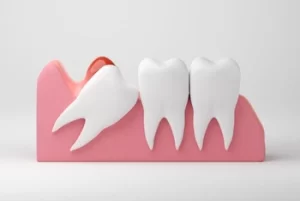 Pericoronitis is inflammation and infection of the gum tissue surrounding a partially erupted tooth. It is one of the most frequent complications associated with wisdom teeth. According to clinical evidence on pericoronitis, the condition is caused by bacteria infecting the gingival tissue around an erupting or partially erupted tooth, most commonly in the lower jaw. Symptoms can include significant pain, swelling, difficulty opening the mouth, and in some cases, spread of infection to the cheek or neck. Left untreated, pericoronitis can become a more serious infection requiring urgent care.
Tooth decay
The gum flap over a partially erupted tooth makes the area difficult to clean. Food and bacteria collect in the space between the flap and the tooth, creating conditions where decay can develop in the wisdom tooth itself or in the second molar directly in front of it.
Pressure on adjacent teeth
If a wisdom tooth is angled toward the tooth in front of it, it can exert pressure on the second molar. This may cause damage to the adjacent tooth’s root or enamel over time.
Cyst formation
In some cases, a fluid-filled cyst can form around an impacted or partially erupted wisdom tooth. Cysts can cause bone damage if left to grow, and their management may involve the removal of both the cyst and the tooth.
How Is a Partially Erupted Wisdom Tooth Treated?
Treatment depends on the degree of eruption, the symptoms present, and the position of the tooth as seen on X-ray.
When a partially erupted wisdom tooth is not causing problems, a dentist may choose to monitor it at regular intervals rather than proceeding immediately to removal. X-rays taken over time can show whether the tooth is moving into a better position or whether complications are developing.
When symptoms are present or problems are recurring, the treatment options for wisdom teeth typically include managing the immediate issue (such as treating an infection with antibiotics and warm salt water rinses) before considering removal. In some cases, the gum flap over the tooth may be removed in a minor procedure called an operculectomy, which can relieve symptoms if the tooth is otherwise well-positioned.
Removal is commonly recommended when a partially erupted wisdom tooth is causing repeated infections, decay in the wisdom tooth or the tooth beside it, or pressure-related damage. Individual outcomes vary, and the decision to remove or retain a wisdom tooth is made based on the specific clinical picture for each patient.
What Does Wisdom Tooth Removal Involve?
Wisdom tooth removal is one of the most common dental procedures. For straightforward cases, it is typically carried out under local anaesthesia at a dental clinic.
The procedure generally involves:
- A small incision in the gum tissue if the tooth is partially covered
- Removal of any bone around the tooth if necessary
- Dividing the tooth into smaller pieces if the angle or size makes extraction in one piece difficult
- Cleaning the socket and, where appropriate, placing stitches to aid healing
More complex cases may require sedation or a general anaesthetic, depending on the tooth’s position and the patient’s medical history. Your dentist will discuss all options and what to expect before any procedure begins.
How to Care for Your Mouth After Wisdom Tooth Removal
Healing after wisdom tooth removal usually takes a few days, with most patients returning to normal activity within a week. The main priority in the first 24 hours is protecting the blood clot that forms in the tooth socket, as this is essential for healing.
General aftercare advice includes:
- Bite gently on gauze for the first hour to help control bleeding
- Avoid rinsing forcefully, using a straw, or spitting in the first 24 hours, as this can dislodge the clot
- Hold warm salt water in your mouth gently after meals, starting no earlier than 24 hours after the procedure
- Eat soft foods for the first few days and avoid hard, crunchy, or chewy items near the extraction site
- Avoid smoking for at least 48 hours after removal, as smoking significantly increases the risk of dry socket
Dry socket (alveolar osteitis) is a painful complication that occurs when the blood clot in the socket is disturbed or fails to form properly. It is more common in people who smoke and can usually be treated effectively by your dentist.
When to See Your Dentist About a Partially Erupted Wisdom Tooth
If you are experiencing jaw pain, swollen gums, bad breath, or any difficulty opening your mouth, these are signs worth raising with your dentist. You do not need to wait until symptoms become severe.
At Beyond 32 Dental, Dr Jeff Lin and Dr Jennifer Chung take the time to thoroughly assess wisdom tooth concerns with X-rays and a clinical examination, and they explain the findings clearly before any decision is made.
Call Beyond 32 Dental on (02) 9158 6334 or book a consultation online.
Frequently Asked Questions
 At what age should wisdom teeth be assessed?
Wisdom teeth typically begin to develop in the mid-teens and emerge in the late teens or early twenties, though this varies between individuals. Dentists often recommend an assessment in the late teens, even before symptoms appear, as X-rays at this stage give a clearer picture of how wisdom teeth are positioned and how much space is available. Earlier assessment and, where necessary, earlier removal tend to be more straightforward, as the roots are less fully formed and the surrounding bone is less dense.
Can a partially erupted wisdom tooth cause ear pain or jaw pain?
Yes. Because wisdom teeth sit close to several nerves and structures in the jaw, referred pain is common. Aching or pressure from a partially erupted wisdom tooth can radiate to the ear, temple, or along the jaw, and may be mistaken for other causes such as ear infection or jaw joint problems. If you are experiencing persistent ear or jaw pain without a clear cause, a dental assessment is worth considering as part of your investigation, particularly if you have not had your wisdom teeth checked recently.
Note: Any surgical or invasive procedure carries risks. Before proceeding, you should seek a second opinion from an appropriately qualified health practitioner.
References
Australian Dental Association. (n.d.). ‘Wisdom teeth’. teeth.org.au. Sydney, NSW: Australian Dental Association. https://www.teeth.org.au/wisdom-teeth
Healthdirect Australia. (n.d.). ‘Removing wisdom teeth’. Healthdirect Australia. Sydney, NSW: Healthdirect Australia. https://www.healthdirect.gov.au/surgery/removing-wisdom-teeth
Kwon, G. and Serra, M. (2022). ‘Pericoronitis’. StatPearls, 21 November. Treasure Island, FL: StatPearls Publishing. https://www.ncbi.nlm.nih.gov/books/NBK576411/
Better Health Channel. (n.d.). ‘Wisdom teeth’. Better Health Channel. Melbourne, VIC: Victorian Government Department of Health. https://www.betterhealth.vic.gov.au/health/conditionsandtreatments/wisdom-teeth


If you've ever had a cavity, chances are you've also had a dental filling. Despite being one of the most common dental procedures, many people Read more

Fluoride has been praised for decades as a champion in the fight against tooth decay. But in recent years, questions have emerged. Is fluoride bad Read more

Bad breath can be embarrassing, especially when it persists despite regular brushing and flossing. If you’ve ever asked yourself, does gingivitis cause bad breath? You’re Read more
Recent Comments